 (424) 373-8211
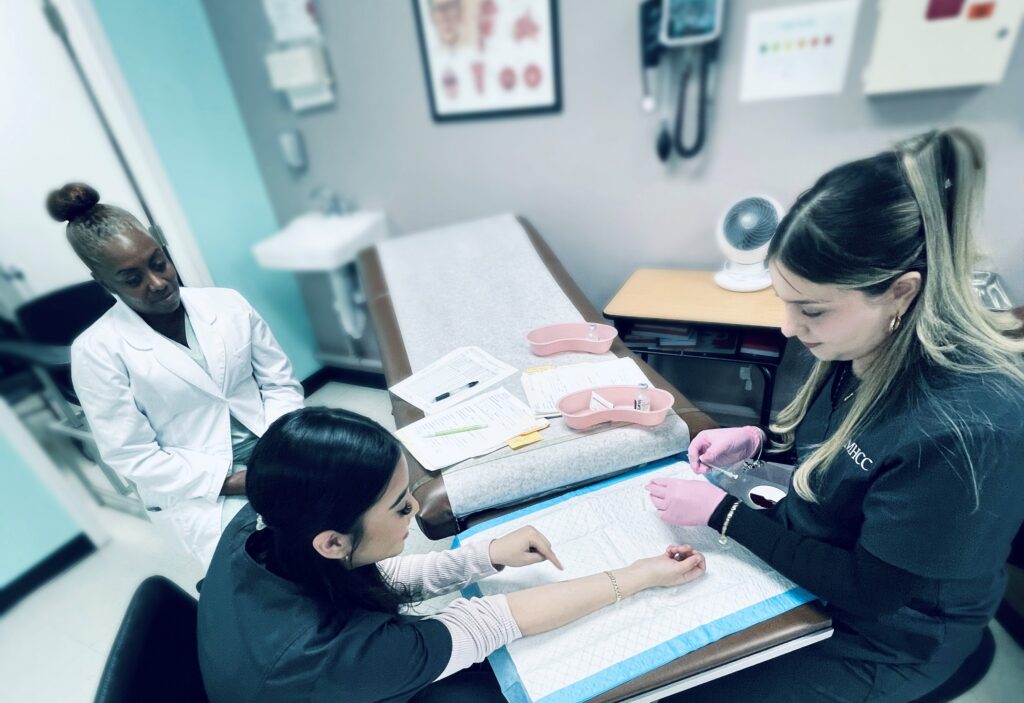
Thinking about becoming a medical assistant? Solid choice. With a 15% job growth rate according to the U.S. Bureau of Labor Statistics, demand is high. But how long does it take to become a medical assistant? What can speed things up or slow you down? And is the time investment worth it? We’re breaking it all down, step by step.
Key Takeaways
- Most students complete a medical assistant program in less than a year. Nationally, timelines range from a few months for certificate programs to about two years if you choose an associate degree.
- At Montes HealthCare College in Gardena, you can finish in about 6 months through the in-person format or around 8 months in the hybrid option, which combines online lectures with on-campus labs.
- Your personal timeline depends on factors like full-time versus part-time enrollment, your outside responsibilities, program structure, and how quickly you schedule your certification exam.
- Medical assisting is considered a fast-entry healthcare career, and the job outlook remains strong, with the U.S. Bureau of Labor Statistics projecting approximately 12% growth from 2024 to 2034, faster than average.
How Long Does it Take to Become a Medical Assistant – Detailed Breakdown
How fast you become a medical assistant depends on the type of program you choose. Here’s how the timelines break down:
Certificate / Diploma Programs (Fastest Route)
Most certificate or diploma programs are designed to be completed in about 9 to 12 months. Some accelerated programs advertise completion in as little as 5 to 6 months, depending on structure and intensity.
At Montes HealthCare College, the timeline is clear and defined:
- In-person Medical Assistant program: approximately 6 months
- Hybrid Medical Assistant program: approximately 8 months
Both formats total 720 clock hours, including a 160-hour externship.
Here’s how those 720 hours break down in our in-person format:
In-Person Medical Assistant Program
| Module Title | Clock Hours |
| Introduction to Medical Assisting Procedures | 140 |
| Anatomy, Physiology, and Terminology with Clinical Laboratory | 140 |
| Front Office Medical Assisting with Clinical Laboratory | 140 |
| Back Office Medical Assisting with Clinical Laboratory | 140 |
| Medical Assistant Externship | 160 |
| Totals | 720 |
Hybrid Medical Assistant Program
| Module Title | Clock Hours |
| The Administrative and Professional Medical Assistant | 80 |
| Introduction to Anatomy and Physiology | 80 |
| Infection Control, Office Environment Safety, The Physical Examination | 80 |
| Administration of Medications, Minor Office Procedure, and Specialty Examinations and Procedures | 80 |
| Hematology, Microbiology, Nutrition, & Emergency Procedures | 80 |
| The Administrative Medical Assistant | 80 |
| The Billing, Coding, and Office Management | 80 |
| Medical Assistant Externship | 160 |
| Totals | 720 |
If you’re specifically looking for the fastest legitimate paths, this breakdown of accelerated medical assistant programs explains what “quick” really means and which timelines are realistic in California.
A former student’s journey offers a clear look at what those 720 hours and the externship really feel like in practice.
Associate Degree Programs (18–24 Months)
Associate degree programs typically take about 18 to 24 months to complete. In addition to core medical assisting skills, students complete general education courses such as English, math, and other foundational subjects.
Is an Associate Degree Worth It?
That depends on your goals. Most medical assistant jobs don’t require a degree, certification is usually enough. Pay is typically the same either way.
That said, having a degree might give you a slight edge in competitive job markets or if you plan to move into other healthcare roles down the line.
On-the-Job Training & Accelerated Options
Some medical assistants are trained directly on the job. While this route can work, it is less structured and may limit eligibility for certain certifications depending on employer requirements.
Accelerated programs compress the same core material into a shorter period. That means more intensive scheduling and a heavier weekly workload.
MHCC’s 6 to 8-month programs are designed to be fast but structured, with a defined curriculum, lab training, and a required externship.
What Actually Fills Those Months?
Those months are structured around skill building, hands-on training, and real clinical exposure.
Clinical Skills You Learn
A large portion of your training focuses on core clinical competencies. These are the practical skills that prepare you to work in an exam room with confidence.
You learn how to:
- Take vital signs such as blood pressure, temperature, pulse, and respiration
- Assist providers during exams and basic office procedures
- Perform or support basic laboratory tasks and specimen collection as covered in your coursework
- Follow infection control and office safety protocols
- Work with common medical equipment used in outpatient settings
Administrative Skills You Practice
Medical assistants often handle both clinical and front office responsibilities. That is why part of your training includes administrative fundamentals.
You practice:
- Scheduling patient appointments
- Managing and organizing patient records
- Working with electronic health record systems
- Understanding basic billing, coding, and office management workflows
Externship: Turning Hours into Real Experience
Both the in-person and hybrid formats include a 160-hour externship, which is part of the total 720 clock hours.
This externship takes place in a real healthcare setting, such as a clinic or doctor’s office. It allows you to apply what you learned in the classroom to actual patient care situations.
During this time, you build confidence, refine your communication skills, and gain exposure to real workflow expectations. While externships do not guarantee employment, they provide valuable hands-on experience and professional connections that can support your transition into the workforce.
4 Factors That Change Your Timeline
So, how long does it take to become a medical assistant? The short answer is: it depends. Your personal timeline can shift based on a handful of things that most people don’t think about upfront. Here’s what can either speed things up or slow you down:
Full-Time vs. Part-Time Enrollment
Going full-time? You could finish in as little as 6-7 months. Part-time? You’re probably looking at 12 months or more, although our part-time, hybrid program takes about 8 months to complete. If you’re juggling work, kids, or life in general, part-time might be your only option, but just know it’ll stretch out the process.
Prerequisite Courses or GED Completion
Some programs won’t let you start until you have a high school diploma or GED. Others make you complete basic math or science courses first. At Montes HealthCare College, we don’t require either. You can jump straight into your core training without those extra steps.
Externship or Clinical Hour Requirements
Most programs include hands-on training in a real clinic or doctor’s office. These externships are non-negotiable and take time to complete. Some are done during the program, while others are tacked on at the end. Either way, they’re a key part of your total timeline.
Exam-Window Availability (AAMA, NCCT, AMT, NHA)
Certification isn’t required to work as a Medical Assistant for most employers, but it’s a smart way to make your resume stand out. Just keep in mind, you can’t just take your certification exam whenever you feel like it. Each certifying body (like AAMA, NCCT, AMT, or NHA) has its own scheduling system. Depending on when your program ends, you might have to wait weeks or even a few months.
Actionable Tips to Stay on (or Beat) Schedule
Want to finish fast and hit the ground running? These small moves can save you weeks down the line.
Knock Out CPR and Health Screenings Before Class Starts
Most programs expect you to show up with CPR certification, background checks, immunizations, and a physical already done. But at Montes HealthCare College, we include CPR/BLS certification as part of your training. No need to get certified before you start.
Overlap Certification Prep with Externship Downtime
Externships usually come with slow moments. Use them to your advantage. Start reviewing for your certification exam while you’re still finishing clinical hours. You’ll retain more (because it’s hands-on), and you won’t waste that in-between time.
Schedule Your Exam the Day You’re Eligible
Don’t wait. Book your certification test the moment you’re allowed to. If you wait “until you feel ready,” life will get in the way. Strike while it’s fresh and your study momentum is still high.
Network During Your Practicum
Your externship site isn’t just practice, it’s a potential employer. Make a solid impression, ask good questions, and build connections. Plenty of grads walk straight into a job because they stood out during clinicals.
Job Outlook & Why the Short Timeline Matters
According to the U.S. Bureau of Labor Statistics, employment of medical assistants is projected to grow about 12% from 2024 to 2034, which is much faster than the average for all occupations.
Thanks to the growth projection, many students can move from researching the career to working in a healthcare setting within months.
For some, medical assisting becomes a long-term career. For others, it serves as a practical stepping stone into additional healthcare training. The combination of strong demand and a short education pathway makes it an appealing entry point into the medical field.
Final Thoughts
It doesn’t have to take years to become a medical assistant. Whether you go the fast-track route with a certificate or take your time with an associate degree, the key is finding a program that works with your life, not against it.
At the end of the day, this career is in demand for a reason. It’s hands-on, it’s meaningful, and it opens doors in the healthcare field. If you’re ready to get started, our medical assistant program is built to get you trained, certified, and out in the field in as little as 6 months. We’ll guide you through every step, from day one to job-ready.
Check out the medical assistant program at Montes Healthcare College and take the first step toward your new career today.
FAQ
Can I work while in school?
Yes, but be realistic. If you’re going part-time, working is totally doable. Full-time programs are more intense, especially once clinicals start. Many students take on weekend or evening shifts, just make sure your job doesn’t burn you out or mess with your study time.
Is there an age limit to start?
Yes, students must be at least 18 years old to enroll. But that’s it. We don’t require a high school diploma or GED. Whether you’re fresh out of school or making a career change in your 40s or 50s, you’re welcome here. It’s never too late to start something new.
What if I already have clinical experience?
It’ll definitely help you feel more confident during training. However, for our Medical Assisting program, all students are required to complete the full coursework. Prior experience can give you a head start in understanding the material, but it won’t replace any part of the program.
How long does it usually take to become a medical assistant?
Nationally, Medical Assistant programs can range from a few months for accelerated certificate programs to about two years for an associate degree. At Montes HealthCare College, students typically finish in about 6 months in the in-person format or around 8 months in the hybrid format.
Can I work while I’m in a medical assistant program?
Many students work part-time while attending school. A part-time job is often manageable with proper time management. Balancing full-time work with a full-time program can be more challenging, especially once externship hours begin.
Do I have to get certified to work as a medical assistant?
Certification is not legally required for every Medical Assistant job. However, many employers prefer or strongly value certified candidates. For that reason, earning certification after completing your training is often the right step to strengthen your resume and expand your job opportunities.